
How IVF Clinics Rank in ChatGPT: The Complete Guide to GEO (Generative Engine Optimization)
Why Some IVF Clinics Get Recommended by ChatGPT, And Others Don't
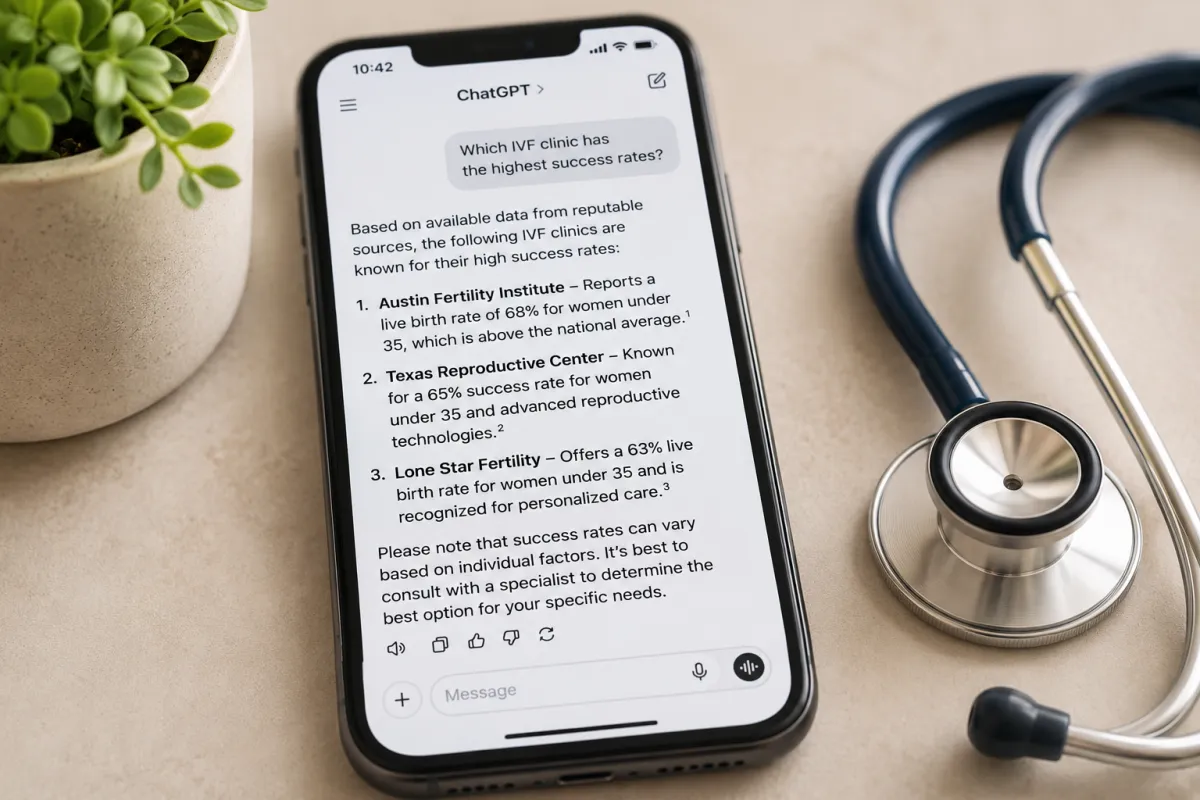
A few years ago, fertility clinics fought for visibility on Google. Today, patients increasingly ask ChatGPT questions like "Which IVF clinic has the highest success rates?" "What is the best fertility clinic near me?" "Which fertility center specializes in donor eggs?" "Who are the top IVF doctors in California?" "What fertility clinic has the best reviews?"
Instead of showing ten blue links, ChatGPT often provides a direct answer. That answer may include only a handful of clinics. The question every fertility practice should be asking is Why does ChatGPT recommend certain IVF clinics while ignoring others?
The answer lies in a new discipline called Generative Engine Optimization (GEO).
What Is GEO?
Generative Engine Optimization (GEO) is the practice of increasing a brand's visibility inside AI-generated answers from systems like ChatGPT, Perplexity, Gemini, Claude, and Google's AI Overviews. Unlike traditional SEO, which focuses on ranking web pages, GEO focuses on getting cited, referenced, and recommended by AI systems. Research from Princeton University introduced GEO as a new optimization framework for generative search engines and demonstrated visibility improvements of up to 40% through optimized content strategies.
In simple terms, SEO helps you rank in Google, and GEO helps you appear in AI answers.
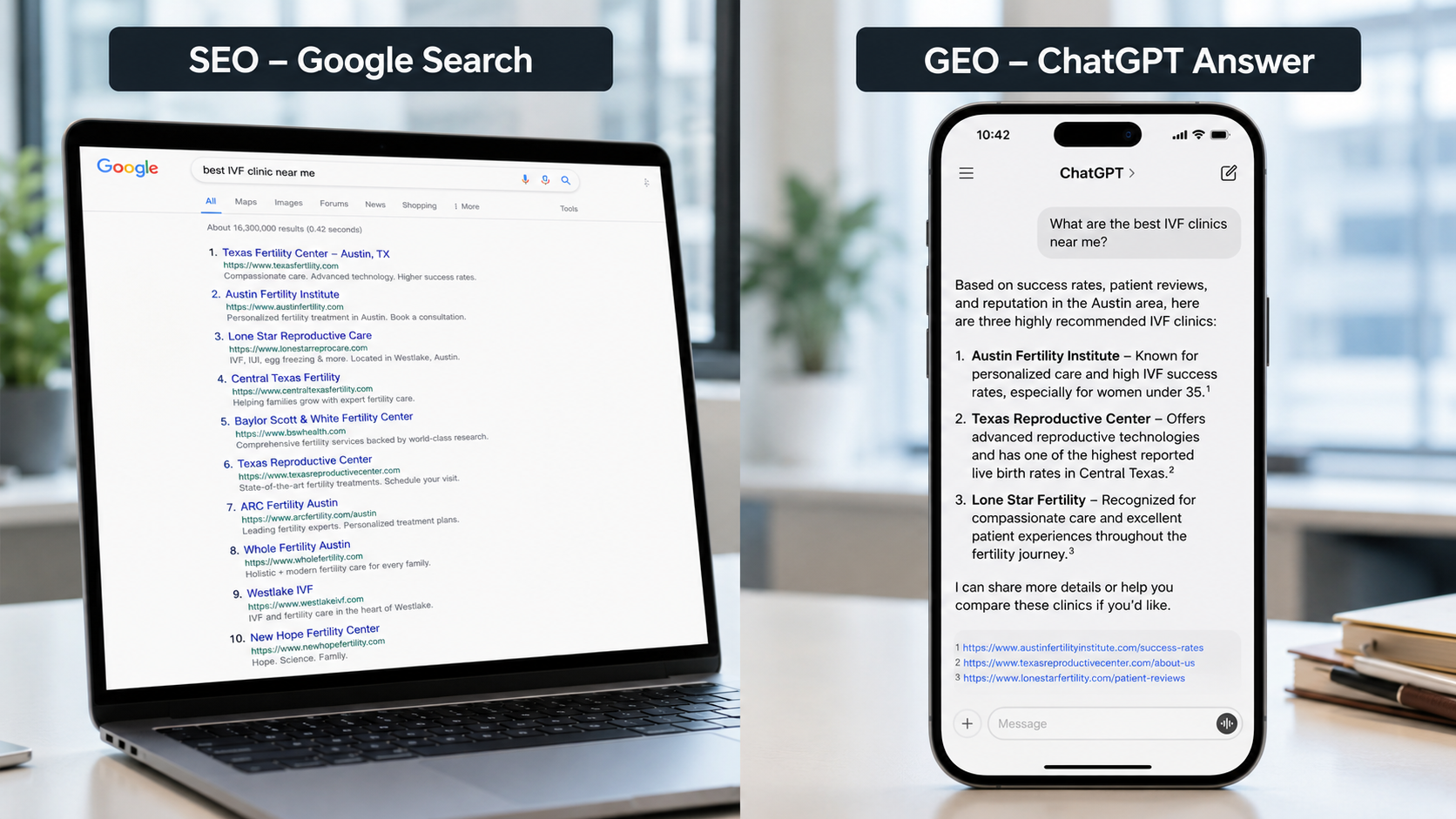
For fertility clinics, this distinction matters because many prospective patients now begin their research inside AI tools before ever visiting Google.
How ChatGPT Finds IVF Clinics
Many clinic owners assume ChatGPT simply scans websites and picks the biggest brands. The reality is more nuanced. Modern AI search systems gather information from clinic websites, medical directories, review platforms, news publications, academic sources, industry publications, third-party mentions, local business profiles, government, and health resources.
When ChatGPT searches the web, it looks for trustworthy information sources and often provides citations back to those sources.
Recent GEO research found that AI search engines display a strong preference for authoritative third-party sources over purely self-promotional content. Earned media and external validation frequently carry more influence than brand-owned content alone.
This means fertility clinics cannot rely solely on their own website. They must build authority across the broader web.
The Four Factors That Influence IVF Clinic Visibility in ChatGPT

1. Authority
AI systems attempt to identify experts for fertility clinics. Authority signals include:
Board-certified reproductive endocrinologists
Published research
Conference presentations
Media mentions
Academic citations
Industry awards
Success rate transparency
A clinic frequently cited by respected healthcare publications is more likely to be referenced by AI systems than a clinic with little external recognition. Research consistently shows AI search engines favor authoritative sources when selecting citations.
Example
Clinic A publishes only promotional service pages. Clinic B is featured in fertility magazines, local news outlets, fertility associations, and research journals. ChatGPT is significantly more likely to trust Clinic B.
2. Structured, AI-Friendly Content
AI systems do not read websites the same way humans do. Studies show that pages containing clear headings, direct answers, statistics, definitions, comparisons, and step-by-step explanations are more likely to influence AI-generated responses. High-performing citations tend to be longer, more structured, and rich in evidence and numerical information.
Example
Poor page:
"Welcome to our fertility center. We provide world-class care."
Better page:
"Houston IVF success rates: 67% for women under 35, according to our 2025 clinic data. Here's how we compare with national averages."
The second version gives AI systems actual information they can cite.
3. Third-Party Validation
One of the biggest GEO findings is that AI engines heavily favor independent validation. Examples include:
Patient reviews
Medical directories
Local publications
Industry rankings
Podcast interviews
Fertility association listings
Guest articles
A fertility clinic mentioned by ten independent sources often appears more credible than a clinic making the same claims on its own website. Research on AI search behavior repeatedly finds a preference for earned media and external authority signals.
Example
Imagine two clinics with identical success rates. One has 300 Google reviews, features in fertility publications, and interviews in healthcare podcasts. The other has none. Which one is ChatGPT more likely to mention? The answer is usually obvious.
4. Entity Recognition
AI systems increasingly understand organizations as entities. An IVF clinic becomes easier to recommend when AI consistently sees the same information across the web:
Clinic name
Physicians
Location
Specialties
Awards
Services
Patient outcomes
If one website calls your practice "ABC Fertility Center," another says "ABC Fertility," and another uses "ABC Reproductive Medicine," AI may struggle to consolidate authority. Consistency matters.
Why Most IVF Clinic Websites Are Invisible to ChatGPT
After reviewing hundreds of fertility clinic websites, common issues include:
Problem #1: Generic Content
Most clinic blogs discuss IVF basics, fertility myths, and treatment overviews. The internet already contains thousands of these articles; AI systems rarely need another generic explanation.
Problem #2: No Original Data
AI favors unique information; most clinics publish no success-rate analyses, cost studies, market reports, patient surveys, or outcome research. Without unique information, there is little reason for AI to cite them.
Problem #3: Weak Digital Footprint
Many clinics have few reviews, few media mentions, few backlinks, and no thought leadership; AI engines have limited evidence to establish authority.
The IVF GEO Strategy That Actually Works
Step 1: Become the Source
Create content that others cite. Examples:
IVF Cost Report 2026
State-by-State Fertility Access Guide
Egg Freezing Trends Report
IVF Success Rate Benchmark Study
Fertility Tourism Analysis
Original research is difficult for competitors to replicate and highly attractive to AI systems.
Step 2: Build Topic Clusters
Instead of publishing isolated blog posts, own entire fertility topics. Example cluster:
Main Guide:
IVF Cost Guide
Supporting Content:
IVF Financing Options
IVF Insurance Coverage
Hidden IVF Costs
IVF Abroad vs U.S. Costs
Employer Fertility Benefits
This helps establish topical authority.
Step 3: Earn Mentions Beyond Your Website
Research indicates AI search engines heavily value third-party authority signals. Focus on:
Healthcare publications
Fertility podcasts
Local media
Medical associations
Guest articles
Industry interviews
The goal is not just backlinks; the goal is to become a recognized source.
Step 4: Answer Real Patient Questions
ChatGPT often receives conversational queries. Examples: "Can I do IVF at 42?" "How many IVF cycles are usually needed?" "Is donor egg IVF worth it?" "What questions should I ask a fertility clinic?"
Create content that answers these questions directly and comprehensively.
Step 5: Monitor AI Visibility
The most advanced fertility clinics now track AI mentions, citation frequency, share of voice, competitor visibility, and prompt performance.
An entire category of GEO tools has emerged specifically to monitor brand visibility across AI platforms.
Case Study Scenario
Imagine two IVF clinics in Dallas.
Clinic A
Strong website
Traditional SEO
Limited PR
Generic content
Clinic B
Publishes fertility research
Appears in healthcare publications
Has hundreds of reviews
Produces data-driven guides
Frequently cited by industry websites
Patient asks, "Which IVF clinics in Dallas are known for high success rates?" ChatGPT is much more likely to mention Clinic B because it has stronger authority signals, richer information, and broader third-party validation. That is GEO in action.
The Future of IVF Marketing
The fertility industry is entering a new search era. Patients increasingly expect direct answers rather than lists of links. The clinics that dominate AI recommendations will not necessarily be the clinics spending the most on advertising. They will be the clinics that become the most trusted sources of information.
SEO is still important. But the next frontier is earning citations inside AI-generated answers. The clinics that invest in GEO today will have a significant advantage as patient discovery continues shifting toward ChatGPT, Gemini, Perplexity, and other AI-powered platforms. Research across AI search ecosystems shows that visibility increasingly depends on being cited, referenced, and absorbed into AI-generated answers rather than merely ranking in traditional search results.
Final Takeaway
If your fertility clinic wants to rank in ChatGPT, stop asking "How do we rank higher in Google?" Start asking, "How do we become the most trustworthy source ChatGPT can cite?" That shift in thinking is the foundation of successful Generative Engine Optimization.


