
Google Ads vs. Meta Ads for Fertility Clinics: Where to Invest Your Budget in 2026
Google Ads vs. Meta Ads for Fertility Clinics: Where to Invest Your Budget in 2026
The fertility services market is booming, generating approximately $7.2 billion annually in the US alone, with the Indian market for IVF clinics growing by a staggering 111% since 2024. As demand rises, so does competition for patient attention, making fertility marketing one of the most dynamic and expensive digital battlegrounds in healthcare.
IVF marketing is unique. You are operating in a high-stakes, emotionally charged market. Patients often research for months before making a decision, and the patient lifetime value can exceed $50,000. This means every lead is high-value, and the cost-per-click is high. Effective fertility marketing requires a nuanced understanding of patient psychology at every stage.
In 2026, the primary paid media channels for clinics are Google Ads and Meta Ads (Facebook/Instagram). But where should you invest your IVF marketing budget to get the best return? Here is the short answer: Google Ads captures high-intent, ready-to-book patients, while Meta Ads builds the pipeline and creates demand. You need both, but you need to understand how they work differently in the context of fertility marketing.
1. The Core Difference: Intent vs. Discovery
The primary distinction between these platforms comes down to patient psychology, a cornerstone of successful fertility marketing.
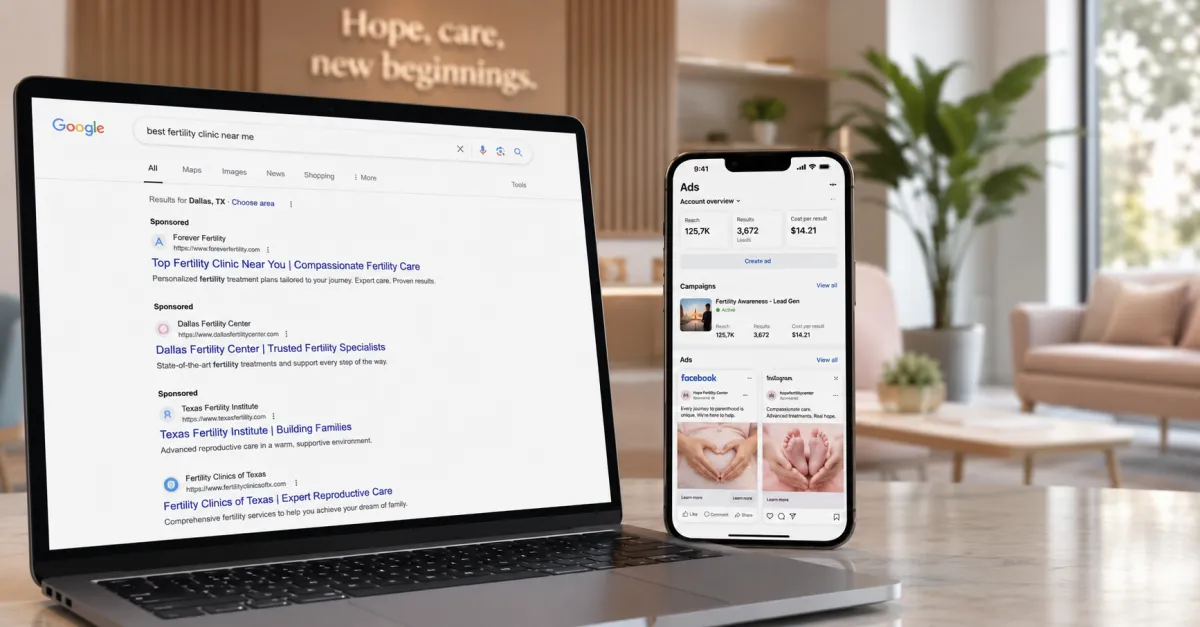
Google Ads (Search): This platform captures high-intent demand. When a potential patient searches for "best IVF clinic near me" or "fertility specialist in Mumbai," they are already in the market. In IVF marketing, you are simply capturing that demand and converting it at the precise moment of decision.
Meta Ads (Facebook/Instagram): This platform is about demand creation and awareness. Patients scrolling through social media are not usually looking for a clinic. However, targeted ads can build brand awareness, trust, and retarget visitors who have already visited your website. In fertility marketing, this is excellent for "discovery" and keeping your clinic top-of-mind during their long research journey, which is often months long.
2. The Numbers: Cost and Conversion Benchmarks
Let's look at the data. Costs vary by location, but the trends are clear and critical for any IVF marketing strategy.
Google Ads Benchmarks (Search Network)
Cost Per Click (CPC): General medical practices see an average CPC of around $4.15**, but for IVF marketing, the CPC can reach approximately **$1.80–$3.60 in key markets.
Cost Per Qualified Lead (CPQL): For IVF, the CPQL can range from $7–$17 depending on the market.
Conversion Rate (CVR): Medical practices see an average of 5.8% on Google Ads. However, OHMRC (One-Hour Micro-Site Consultation) landing pages can boost this to 22–28% for fertility services, making this a high-leverage tactic in fertility marketing.
Patient Value: An IVF cycle costs $15,000–$25,000 in the US, meaning a high CPC is justified by the massive return, which is why IVF marketing often commands larger ad budgets.
Meta Ads Benchmarks (Facebook & Instagram)
Cost Per Click (CPC): Facebook Ads are generally cheaper, with a healthcare average of $1.95**. IVF marketing campaigns can see CPCs as low as **$5–$8 when using Click-to-WhatsApp.
Cost Per Lead (CPL): Fertility clinics can achieve Meta CPLs of $5–$8 for Click-to-WhatsApp campaigns. This is significantly lower than the general medical practice CPL of $47.47, making it an attractive volume play in fertility marketing.
Conversion Rate (CVR): The conversion rate on Facebook is much lower, averaging 1.8% for medical practices. This is because users are not actively searching, reminding fertility marketing professionals that Meta is a top-of-funnel tool.
3. The Case Studies: Proof in the Numbers
The theory is backed by real-world performance, offering clear lessons for fertility marketing strategies.
Precision IVF: A clinic running targeted Google Ads with a budget of $1,200/month generated over 40 booked appointments per month and achieved a 300% increase in conversions. This showcases the power of search ads to fill the appointment book, proving that search-based IVF marketing delivers immediate, tangible results.
Elysian Fertility and Surrogacy: In a Harvard Business Review case study, this clinic analyzed its $1.44 million marketing budget to balance spend across digital channels to maximize ROI in a competitive market. The challenge is exactly what every fertility marketing leader faces today: strategic allocation across platforms.
ICG Portfolio: Data from 20+ IVF clinics managed by ICG shows that Google Ads delivers the fastest consultations, while Meta Ads delivers the most volume at a moderate cost. This dual-pronged insight is the foundation of any data-driven IVF marketing plan.
4. Strategic Scenarios: How to Allocate Your Budget
Your budget allocation depends on your clinic's goals and size. Here is how fertility marketing experts approach different scenarios.
Scenario A: The New Clinic (Brand Building)
Goal: Awareness and lead generation.
Strategy: You need to be visible. A larger portion of your budget should go toward Meta Ads to build awareness and create demand in your local area. Pair this with an aggressive SEO strategy to start building organic authority. In early-stage fertility marketing, awareness is more valuable than immediate conversions.
Allocation: 60% Meta, 40% Google.
Scenario B: The Established Clinic (Bookings)
Goal: Fill appointment slots.
Strategy: If you already have a strong referral base and brand recognition, Google Ads is your tool for capturing ready-to-book patients. Focus on high-intent keywords for treatments like IVF and Egg Freezing. This is the most profitable segment of IVF marketing for mature clinics.
Allocation: 60% Google, 30% Meta (Retargeting), 10% Display/Programmatic .
Scenario C: The Multi-Location Chain
Goal: Dominating the local market in multiple cities.
Strategy: A full-funnel approach is required. Use Google Ads for high-intent capture, Meta for brand recall and retargeting, and YouTube for educational content that builds trust over the long term. This omnichannel approach represents the gold standard in fertility marketing for large groups.
Allocation: 35% Google, 30% Meta, 15% Display, 10% YouTube.
5. The Winning Strategy: The Blended Funnel
In 2026, the most successful fertility clinics do not choose one over the other. They use a blended strategy where each platform supports the other, and this is the future of IVF marketing.
Top of Funnel (Awareness): Use Meta Ads and YouTube to educate and build trust. Your content here is "5 Questions to Ask Your Fertility Doctor" or "What to Expect During IVF." In fertility marketing, this is where you build the emotional connection.
Middle of Funnel (Consideration): Retarget those who engaged with your content on Meta and send them to a deep-dive landing page about your specific success rates or technology. Smart IVF marketing uses retargeting to bridge the gap between discovery and decision.
Bottom of Funnel (Conversion): Use Google Ads to target "book an IVF consultation" or "fertility clinic near me" to capture the lead and convert them into an appointment. This is the final, critical step in any results-driven fertility marketing campaign.
6. Budget Considerations for 2026
Google Ads: For an IVF clinic in a major city, the minimum effective spend is approximately $1,800 per month. Below this, the algorithm struggles to optimize, making it a waste of fertility marketing budget.
Meta Ads: The minimum is often lower, but remember that Meta leads are "colder." You need a strong follow-up system (often via WhatsApp) to convert them to bookings. Ignoring this follow-up is the number one mistake in IVF marketing on Meta.
Market Spend: Total healthcare digital advertising hit significant figures in 2026, with Google Ads and Meta Ads accounting for major shares of the overall spend. This illustrates the industry's reliance on both pillars, confirming that holistic fertility marketing is the industry standard.
7. Which One Wins? The Verdict.
There is no single winner when it comes to fertility marketing. Google Ads wins on conversion intent and speed to consultation, while Meta Ads wins on volume and cost-per-lead.
Google Ads is your "surgical strike" for patients who need you right now, making it the conversion engine of your IVF marketing.
Meta Ads is your "boulder rolling," slow to start, but it builds momentum to create a consistent pipeline of potential patients who already know your name. It is the long-term brand builder in your fertility marketing arsenal.
For a holistic SEO and PPC strategy, ensure your website and ads are compliant with guidelines to maximize your online visibility. When you align both channels, your IVF marketing ROI will outperform single-channel strategies every time.


